Showing posts with label Rendezvous Point. Show all posts

Thursday, August 23, 2012

JMeter Terminology - Synchronizing Timer

I was tasked to perform a performance test for a web application using JMeter. Personally, I have some experience with LoadRunner but not JMeter. For one of the scenario, I need to simulate something like a Rendezvous Point in LoadRunner, therefore I was googling for something similar in JMeter and here it goes:- Synchronizing Timer

Rendezvous Point (LR) = Synchronizing Timer (JMeter)

Source: Synchronizing Timer

Synchronizing Timer

The purpose of the Sync Timer is to block threads until X number of threads have been blocked, and then they are all released at once. A SyncTimer can thus create large instant loads at various points of the test plan.

Control Panel:
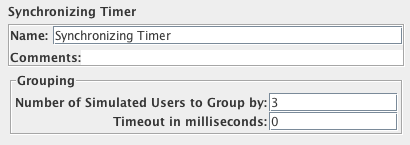

Synchronizing Timer
Parameters:

Attribute (1): Name
Description: Descriptive Name for the timer that is shown in the tree
Required: No

Attribute (2): Number of Simulated Users to Group by
Description: Number of threads to release at once. Setting it to 0 is equivalent to setting it to Number of threads in Thread Group.
Required: Yes

LoadRunner Terminology - Rendezvous Point

Source: Load Runner Stress Testing using Rendezvous Points

Using Rendezvous Points:

A rendezvous point creates intense user loads on the server and enabled LoadRunner to measure server performance under load. Using rendezvous point we can instruct multiple Vusers to perform tasks simultaneously. We define rendezvous points in the Vuser script, and control using the controller. The controller releases the Vusers from the rendezvous either when the required number of Vusers arrives, or when a specified amount of time has passed.

Procedure to control load peaks on the server:

1. Create Vusers scripts, inserting the necessary rendezvous points.
2. Create a scenario.
3. Set the level of emulated user load.
4. Set the attributes for the rendezvous.
5. Run the scenario.


3 Rendezvous Attributes:

1. Release when X% of all Vusers arrive at the rendezvous.
2. Release when X% of all running Vusers arrive at the rendezvous. 
3. Release when X Vusers arrive at the rendezvous.